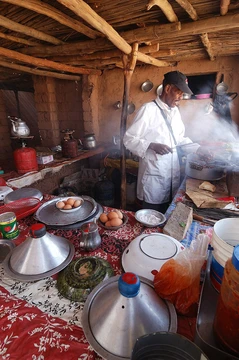
Stew
A slow-cooked dish of ingredients in liquid, known since ancient times.

Wikipedia / Wikimedia Commons
A stew is a dish made by cooking solid food ingredients in liquid, with the resulting gravy served alongside. The ingredients can include any mix of vegetables, and often feature meat—particularly tougher cuts that benefit from slow cooking, like beef, pork, venison, rabbit, lamb, poultry, sausages, or seafood. While water can serve as the cooking liquid, stock is also common, and a small amount of red wine or other alcohol may be added for flavor, along with seasonings and other flavorings. Stews are usually cooked at a low temperature, simmering rather than boiling, which allows the flavors to blend together.
Stewing works well for less tender cuts of meat, which become tender and juicy through slow, moist heat, making it a popular method for low-cost cooking. Cuts with marbling and gelatinous connective tissue yield moist, juicy stews, while lean meat can easily turn dry. Stews are thickened either by reducing the liquid or by adding flour—for instance, coating meat pieces with flour before searing, or using a roux or beurre manié (a dough of equal parts fat and flour). Other thickeners like cornstarch, potato starch, or arrowroot may also be used. Stew is especially prominent in England, where beef stew with dumplings has long been a cherished dish, and other European countries have their own versions.
**History** Stews have been made since ancient times. The oldest known evidence of stew comes from Franchthi Cave in Greece, dating to around 7000–6000 BC, where cooking vessels show traces of slow-cooked meat and liquid. Amazonian tribes used turtle shells as vessels to boil the entrails of the turtle along with other ingredients. The Roman cookbook *Apicius*, believed to date from the 4th century AD, includes recipes for pork and fish stews. *Le Viandier*, one of the earliest French cookbooks, compiled in the early 14th century and often attributed to the chef Taillevent (though his authorship is debated), contains various types of ragouts or stews.
**Types** There is a wide variety of stews, including those with meat or seafood, as well as vegetarian or vegan versions. White stews, also called blanquettes or fricassées, are made with lamb or veal that is blanched or lightly seared without browning, then cooked in stock. Brown stews use pieces of red meat that are first seared or browned, followed by a
- earliest_evidence
- c. 7000–6000 BC, Franchthi Cave, Greece
Lore & Background
Stews have been made since ancient times. The world's oldest known evidence of stew was found in Franchthi Cave in Greece, dating to around 7000–6000 BC, where cooking vessels show traces of slow-cooked meat and liquid. Amazonian tribes used the shells of turtles as vessels, boiling the entrails of the turtle and various other ingredients in them. There are recipes for pork stews and fish stews in the Roman cookery book Apicius, believed to date from the 4th century AD. Le Viandier, one of the oldest cookbooks in French, compiled in the early 14th century and often attributed to the chef known as Taillevent (though his authorship is debated), has ragouts or stews of various types in it.
Reader's Guide
Stew is a versatile dish that has been a staple across many cultures for millennia. Its significance lies in its ability to make tough, inexpensive cuts of meat tender through slow, moist cooking, and to combine a wide variety of ingredients into a single, flavorful meal. Stews are thickened by reduction or with flour, either by coating pieces of meat with flour before searing or by using a roux or beurre manié. Thickeners like cornstarch, potato starch, or arrowroot may also be used. Stew is very prominent in England, with beef stew and dumplings having been one of England's national dishes in the 14th century. Other European countries also have their own recipes. The legacy of stew is reflected in the vast number of regional variations, from French beef bourguignon to Hungarian goulash, Polish bigos, and Mexican birria, demonstrating its adaptability to local ingredients and tastes. Its enduring popularity is due to its simplicity, economy, and the depth of flavor achieved through slow simmering.
Did You Know?
- The world's oldest known evidence of stew was found in Franchthi Cave, Greece, dating to around 7000–6000 BC.
- Amazonian tribes used turtle shells as vessels to boil entrails and other ingredients.
- Stew is very prominent in England, with beef stew and dumplings being a beloved dish, though dumplings as known today were not common in the 14th century, and the concept of a 'national dish' is anachronistic for that pe
- Stews are
More in Food & Cooking 1-24
Spotted an error? Know more?
This is a living reference — every entry is fact-audited, and reader corrections feed straight into our audit queue. Suggest an edit · See this site's audit record